
0

Fragment Compound Database

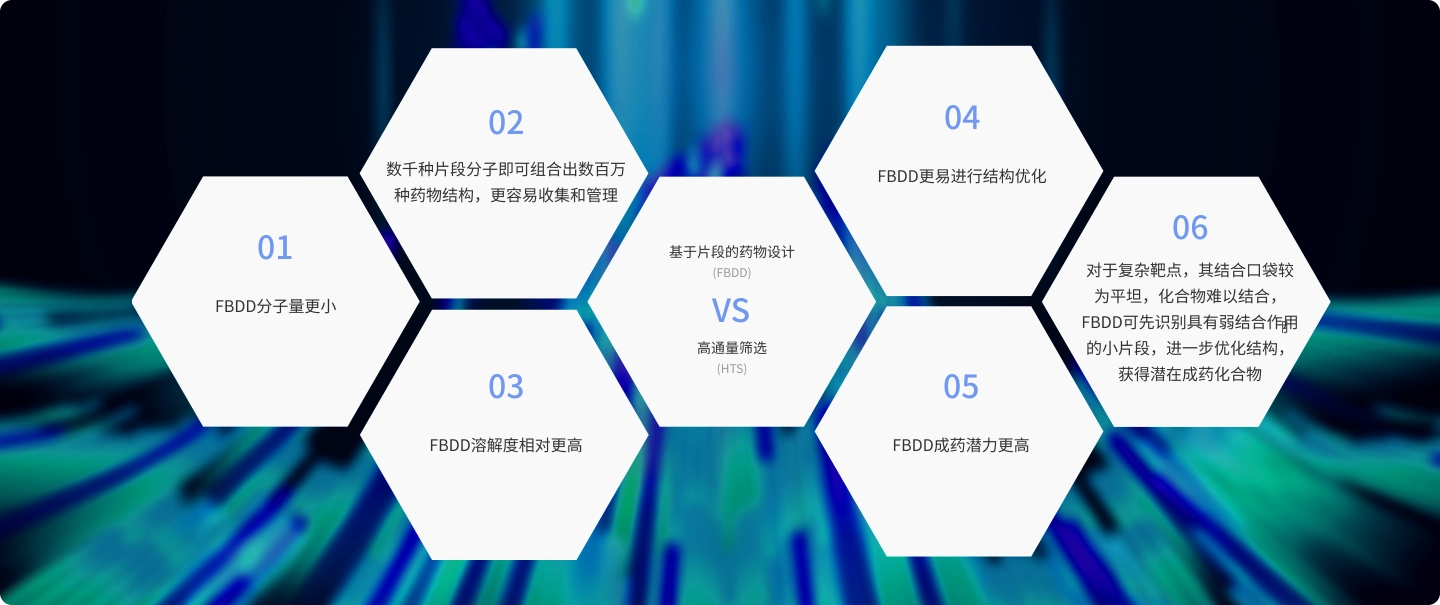
The theoretical foundation of Fragment-Based Drug Design (FBDD) lies in the selection, combination, or expansion of advantageous molecular fragments to construct new drug molecules with high potency. Compared to High-Throughput Screening (HTS), a library of just a few thousand fragments can represent millions of potential drug-like structures, making them easier to curate and manage. Furthermore, fragments typically possess lower molecular weights and higher solubility, facilitating structural optimization and enhancing overall drug-likeness.

Fragment-Based Drug Design
AnyMol Fragment Compound Database
Proven Success in FBDD
In addressing complex targets such as Protein-Protein Interactions (PPIs), where binding pockets are often flat and difficult for traditional compounds to occupy, HTS frequently hits a bottleneck. FBDD overcomes this by identifying small fragments with initial weak binding, which serve as the foundation for structural growth into clinical-grade compounds.
To date, this methodology has yielded numerous small-molecule drugs, with over 30 candidates entering clinical trials and two notable FDA-approved drugs: Vemurafenib & Venetoclax
Given its proven track record, FBDD is increasingly becoming the preferred approach for drug discovery experts globally.
AnyMol’s Expertise in Selecting Fragment Compounds
A high-quality fragment library is the prerequisite for a successful FBDD program. When curating such libraries, we strictly adhere to the Rule of Three (Ro3) and other critical parameters:
MW < 300, HBA ≤ 3, HBD ≤ 3, Rotatable Bonds ≤ 3, cLogP ≤ 3. Beyond these criteria, we consider 3D structural diversity and aqueous solubility. For researchers targeting specific chemical environments, we offer specialized libraries such as Fluorine-labeled (19F) or Bromine-labeled fragment sets.
By selecting a fragment library tailored to specific experimental needs, researchers can narrow their screening scope and design drugs more rationally, significantly reducing the difficulty of subsequent development. AnyMol provides data for over 460,000 fragment compounds, offering researchers an unparalleled breadth of choice for their discovery pipelines.
Submit Your Request
Please complete the technical requirement form below, and our team will get back to you as soon as possible!
Verification Code
TargetMol | Target Loading
Loading ~