



Virtual Screening / Molecular Docking
TargetMol | Copyrighted software
One-stop SolutionAn AI-powered drug discovery platformto facilitate the identification of PCC.
TargetMol | Copyrighted software
Rich Project ExperienceProviding products and services tothousands of organizations worldwide
TargetMol | Copyrighted software
Rapid ScreeningAI-driven rapid screening toaccelerate drug discovery
TargetMol | Copyrighted software
Expert TeamUtilizing multiple professional softwaretools and proprietary algorithms.
Virtual Screenig/Molecular Docking

01/Molecular Docking Based Virtual Screening

Molecular Docking Based Virtual Screening

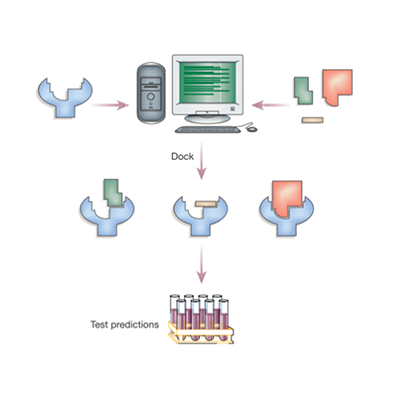
Molecular docking is a drug screening approach based on the three-dimensional structure of target proteins.

By docking small-molecule compounds with target proteins, both scoring functions and spatial conformations are comprehensively analyzed, including electrostatic interactions, hydrogen bonding, hydrophobic interactions, and van der Waals forces.
This approach enables the exploration of the binding modes and conformations between small-molecule ligands and macromolecular receptors, helping to explain the origin of compound activity and providing guidance for rational structure optimization.

With the support of binding affinity scoring functions, the interaction strength between small molecules and target proteins can be quantitatively evaluated, offering a reliable basis for candidate selection and the identification of potentially active compounds for experimental validation.

Virtual screening based on molecular docking is one of the most promising tools in modern drug discovery. As this method places minimal restrictions on compound structures, it holds great potential for identifying structurally novel lead compounds.

Molecular Docking Based Virtual Screening

02/Pharmacophore Based Virtual Screening

Pharmacophore Based Virtual Screening

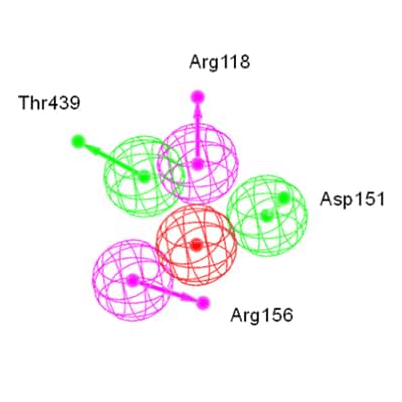
Pharmacophore modeling is an efficient drug screening approach based on the key features of small-molecule compounds.

By analyzing the pharmacophoric characteristics of one or more active molecules, the essential features responsible for biological activity can be identified. Pharmacophore screening requires relatively low computational cost and can be performed prior to molecular docking. It enables rapid screening of millions to tens of millions of compounds within a short timeframe.

With as few as one or several active compounds provided by the customer, a common pharmacophore model can be constructed to screen for molecules with similar features and guide the design and synthesis of new active compounds.

In addition, some molecular modeling software offers methods to predict the biological activity of matched molecules, such as pharmacophore-based QSAR models.
However, virtual screening based on pharmacophore models often yields compounds with structural properties similar to those used to build the model, which may limit the discovery of novel scaffolds for lead optimization.

Molecular Docking Based Virtual Screening
Cases
Case 1

In this case, we applied molecular docking techniques to investigate the binding ability of Compound 1with the PARP1 protein.
The DOCK 6.7 program was used to predict the binding modes of Compound 1 within PARP1, retaining up to 20 docking conformations.

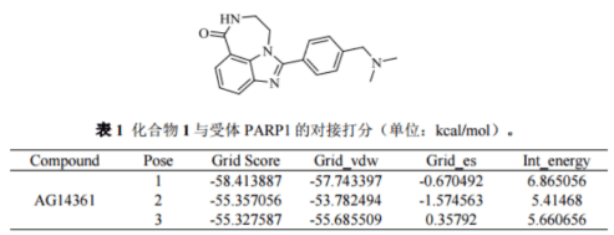
The results indicated that multiple docking conformations were present at the binding site, with their corresponding scores shown in Table 1.
Based on the docking scores and binding modes, the second-ranked docking conformation was selected for further analysis of the interaction pattern.

Case 2

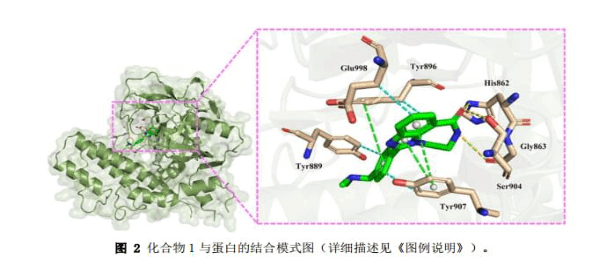
The amide carbonyl oxygen atom on the seven-membered ring of Compound 1 forms hydrogen bond interactions with the amino acid residues Ser904 and His862. Meanwhile, the amide nitrogen atom forms a hydrogen bond interaction with Gly863 at a distance of 3.33 Å. These interactions help anchor the binding orientation of the compound and contribute to electrostatic interactions (Grid_es = -1.574563 kcal/mol).
The two rings of the benzimidazole moiety form parallel π–π stacking interactions with Tyr90, with centroid–centroid distances of 4.21 Å and 4.93 Å, respectively.

In addition, the side-chain phenyl ring forms a T-shaped π–π stacking interaction with Tyr896, with a centroid distance of 5.47 Å.
At the same time, the compound also forms hydrophobic interactions with residues Tyr889, Tyr896, Tyr907, and Glu998. These hydrophobic and π–π stacking interactions provide strong van der Waals contributions (Grid_vdw = -53.78 kcal/mol).
In summary, the interaction between Compound 1 and the protein PARP1 is mainly driven by π–π stacking and hydrophobic interactions, while hydrogen bonds help stabilize and lock the binding orientation.

Contact Us

Basic Information

*Contact Name

*Contact Information

*Shipping Address

*Company Organization

*Email Address

We can provide the following items

In order to facilitate subsequent record operations, please first Register or Login user account

Virtual Screening
Molecular Docking
Molecular Dynamics
Target Fishing
Calculation Parameters
QSAR Model
Homology Modeling
Other

*Select Category

*Protein Information

Upload file(support .pdb .FASTA)

Functional Region to Be Screened

Additional Information

*Expected period

*Project budget

*Verification Code

Verification Code
TargetMol | Target Loading
Loading ~